

The Zoo worked alongside TriStar Skyline Medical Center on a unique research initiative to study how anteater blood coagulates using thromboelastography (TEG) testing. The study took place over a series of days at the beginning of May when our Veterinary Team took samples and rushed them over to TriStar Skyline for testing. TriStar Skyline is one of the few hospitals in the region with the specialized lab technology needed to perform this advanced testing, making the facility a critical part of the study.

Nashville Zoo Veterinary Team performs a voluntary blood draw on a giant anteater.
Giant anteaters have a history of coagulopathies, also known as blood disorders, due to their unique physiology. Currently, these disorders have been managed using specialized diets under animal healthcare. To advance specialized care for anteaters, this study was created to investigate the normal coagulation pathways in giant anteaters using multiple different technologies. The information from this study will serve as a valuable resource for zoo clinicians working with giant anteaters in zoos and in the wild.
Nashville Zoo had two goals in mind while studying coagulation in giant anteaters. The first goal was to utilize thromboelastography (TEG), a machine that evaluates clot formation, stability, and breakdown, which is the gold standard and operated by TriStar Skyline’s lab. The second goal was to perform Viscoelastic Coagulation Monitoring (VCM), a more simplified, point-of-care approach, which was operated in the Anteater barn using a machine the Zoo borrowed from BluePearl Pet Hospital of Franklin. Each of these technologies have differences in pricing and availability, so comparing the tests in this study will also allow the Zoo to assess their compatibility and give veterinarians options for assessing coagulation in animals under their care.
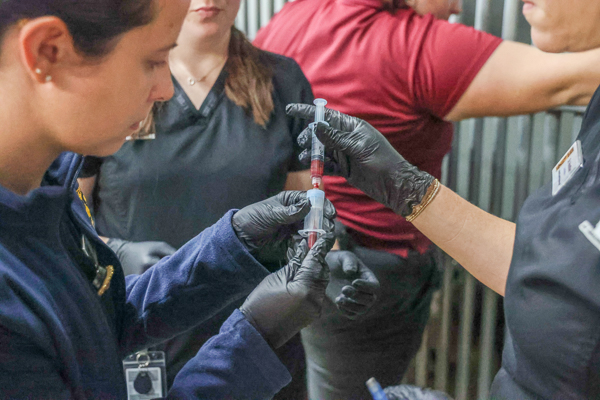
Nashville Zoo Veterinary Team transfers blood to a collection tube.
“Most institutions are unable to perform voluntary blood draws on their giant anteaters, and ours are not only trained but are remarkably patient and forgiving when it comes to venipuncture,” said Nashville Zoo Veterinary Intern Dr. Lauren Vincent. “This study started as a wild idea when we were performing routine physical exams on our giant anteaters, and within a couple of weeks we had the support of the TriStar Skyline team and received approval from the Zoo administration. It is just a great example of people from diverse backgrounds coming together for the sake of conservation.”
The study was a momentous success, and our Veterinary Team was able to get samples on all nine of its giant anteaters. TEG and VCM produced graphs with their results, and the team discovered these were different from typical dog and cat values. This is valuable information for veterinarians working with these animals because most of the published reference ranges are from small animal medicine and are not as accurate for anteaters.
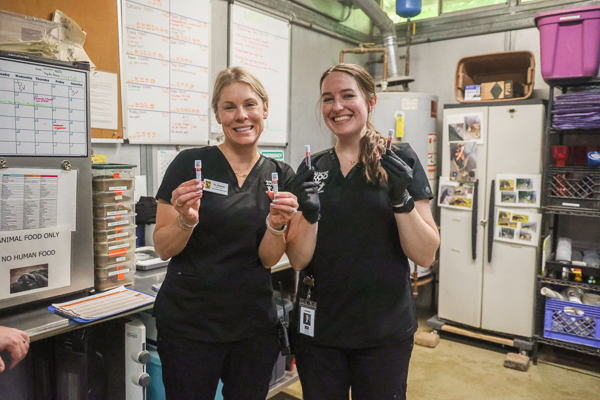
Director of Animal Health, Heather Schwartz DVM and Veterinary Intern, Lauren Vincent DVM.
This study was made successful through a collaboration between TriStar Skyline’s laboratory team, Joshua Justice MD, FACEP, and the Emergency Medicine Residency Program. Dr. Justice along with Brian P. Marger, the chief executive officer of TriStar, spearheaded the effort to support this study at their lab. Additionally, Nashville Zoo partnered with Dr. Hamm at BluePearl of Franklin. The team allowed the Zoo to use their tableside VCM Machine.
“The project not only expands veterinary understanding of clotting in giant anteaters, it also provides our residents with a rare opportunity to apply clinical tools in a cross-disciplinary setting that supports animal care and conservation,” said Dr. Justice at TriStar Skyline.
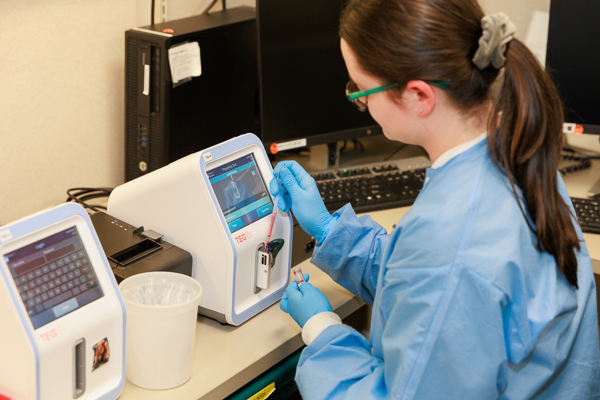
Lab tech loading blood sample into TEG machine at Tristar Skyline Medical Center.
The study will be published within the year and can be read in veterinarian journals. For more information on Nashville Zoo’s animal healthcare, visit here. For more information about TriStar Skyline Medical Center, visit here.